
Height Safety Equipment Inspection: What Queensland Businesses Need to Know
Falls from height remain one of the leading causes of serious workplace injury and fatality across Queensland, with construction, building maintenance and roof access work dominating Workplace Health and Safety Queensland (WHSQ) incident notifications. WHSQ compliance campaigns have sharpened focus on whether equipment is being inspected at the cadence required by the standards. For a facility manager, site supervisor or body corporate, a Queensland height safety inspection obligation is no longer a paperwork exercise; it is a documented, signed and tagged duty under the Work Health and Safety Act 2011 (Qld).
Aegis Sales & Service operates as a technical authority in this space, carrying out inspections per AS/NZS 1891.4:2009, manufacturer’s instructions and the Workplace Health and Safety Act. This guide sets out clear cadences, concrete fault categories and an honest framing of what AS/NZS 1891 compliance looks like on a working site.
1. The High Stakes of Queensland Safety
Working at height carries two layers of risk: the immediate consequence of a fall, and the longer-tail consequence of equipment failing during fall arrest. A harness that has spent 18 months in a ute toolbox under the Queensland sun, lightly contaminated with hydraulic oil, and never formally inspected is a piece of gear nobody should be relying on. Inspectors routinely ask to see current inspection certificates alongside risk assessments and SWMS.
Queensland courts treat documented inspection regimes as central evidence of due diligence. A site without a verified inspection record cannot demonstrate the duty holder did what was reasonably practicable, and that is the gap a properly run height safety regime closes.
2. The Legal Framework: Regulations and Standards
Three layers govern inspection of fall arrest equipment in Queensland. The Work Health and Safety Act 2011 (Qld) sets the primary duty of care; a PCBU must do what is reasonably practicable to protect workers from fall hazards, and the duty is non-delegable. Sitting under the Act, the Managing the Risk of Falls at Workplaces Code of Practice sets out the practical control measures expected on Queensland sites: the hierarchy of control, edge-protection priorities, and the documentation regulators look for during a visit.
The technical benchmark for the equipment is AS/NZS 1891.4, the selection, use and maintenance standard for industrial fall arrest systems. AS/NZS 1891.4:2009 is the version Aegis cites on its inspection service page, alongside AS/NZS 1891.1 for harness design and AS/NZS 1891.2 for horizontal lifelines. Safe Work Australia maintains the model WHS framework that these Queensland instruments align to. Any harness, lanyard, anchor, or static line on site needs to be certified to the relevant 1891 part and inspected to the AS/NZS 1891.4 cadence, regardless of where the gear was bought.
3. Mandatory Inspection Intervals: 6 and 12 Month Rules
Cadence is where most Queensland businesses get caught short. Soft goods (webbing harnesses, lanyards, energy absorbers) and fixed systems (anchor points, static lines, rigid rails) sit on different cycles, with different documentation expectations. The table below summarises the cadence Aegis applies and the broader industry position under AS/NZS 1891.4.
|
Equipment Type |
Inspection Type |
Cadence |
Authority |
|
Soft goods (harnesses, lanyards, energy absorbers) |
Formal Certified Inspection |
6-monthly |
AS/NZS 1891.4:2009 |
|
Fixed systems (anchor points, static lines, rigid rails) |
Recertification |
12-monthly |
AS/NZS 1891.4 industry standard |
|
Pre-start |
Visual check by user |
Every use |
WHS Act duty of care |
|
Post-fall |
Quarantine and formal inspection |
Immediate |
AS/NZS 1891.4 |
The 6-monthly Formal Certified Inspection cadence for soft goods is the figure Aegis runs to and publishes on its height safety inspection service page. UV degradation, abrasion, perspiration salts and chemical exposure are cumulative on textile components, and the six-month cycle exists because soft goods can degrade faster than visual inspection alone will catch. Brands stocked through Aegis (SpanSet body harnesses such as the 1100 ERGO iplus Premium and 1100 ERGO Economy, plus MSA Latchways fall limiters) sit under this cadence.
For fixed systems, recertification on a 12-monthly cycle is the AS/NZS 1891.4 industry standard for anchor points, static lines and rigid rails. This scope typically involves load-test procedures, structural attachment review, and certifier sign-off; Aegis offers it as part of the roof safety inspection service. Permanent fall arrest hardware (Honeywell Miller Engineered Systems, including Soll MultiRail) belongs in this category, not the soft-goods category.
Pre-start checks sit atop the formal cadences. Every user has a duty of care obligation to visually inspect a harness, lanyard, and connector before each use. The post-fall protocol is absolute: any equipment involved in a fall arrest event is quarantined immediately, removed from service and either formally inspected or destroyed. NATA-accredited calibration (Aegis accreditation No. 20700) sits adjacent to height safety, applying primarily to gas detection and instrumentation, though the same documentation discipline carries across.
4. Identifying Faults: What Inspectors Look For
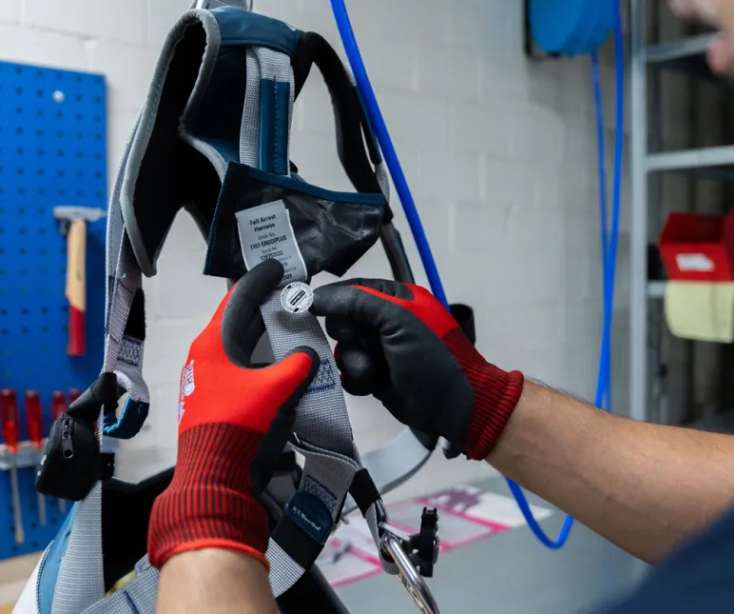
A formal inspection is more rigorous than the pre-start check. On webbing and stitching, inspectors check for sun-bleaching (a strong indicator of UV-induced strength loss), fraying, cuts, chemical burns, pulled stitching at load anchorages and heat damage from welding sparks. Stitching is a particular focus because failure of the load-bearing thread is often the first indicator of harness retirement.
Hardware inspection focuses on the metal components. D-rings, buckles and adjusters are checked for corrosion, deformation, sharp edges and wear at contact points; karabiners are checked for gate-locking failures and any deformation of the major axis (see the Aegis karabiners, connectors and anchors range). Any item that fails inspection is quarantined, tagged out of service, and either repaired by the manufacturer’s authorised technician or destroyed; field repairs are not permitted under AS/NZS 1891.4.
Documentation closes the loop. Inspected gear is tagged with the inspector’s identifier, the next due date, and a corresponding certificate is issued for the asset register. A site holding compliant equipment without the tag plus certificate is, from a WHSQ perspective, a compliance failure. If the paperwork is not there, the inspection effectively didn’t happen.
5. The Aegis Advantage in Height Safety
Aegis Sales & Service runs the inspection service from its Geebung head office at 1/119 Delta Street, Geebung QLD 4034 (07 3865 1139, Monday to Friday 8:00am to 4:30pm) and its Chinchilla showroom at 21 Chinchilla Street, Chinchilla QLD 4413 (1800 234 477, Monday to Friday 7:30am to 4:00pm). The Geebung site supports south-east Queensland turnaround on soft-goods inspection, and the Chinchilla showroom places a service point directly into the Surat Basin gas corridor for fly-in crews between rotations.
The service offer is built on equipment, expertise and education. Aegis carries the body harness range (SpanSet and MSA), connectors and anchor points, pole straps, single webbing lanyards and fall limiters, plus the Honeywell Miller Engineered Systems range for permanent fall arrest. Pre-handover inspections are offered for newly installed systems, and a move toward digital asset registers through 2026 will give customers searchable records rather than a folder of PDFs.
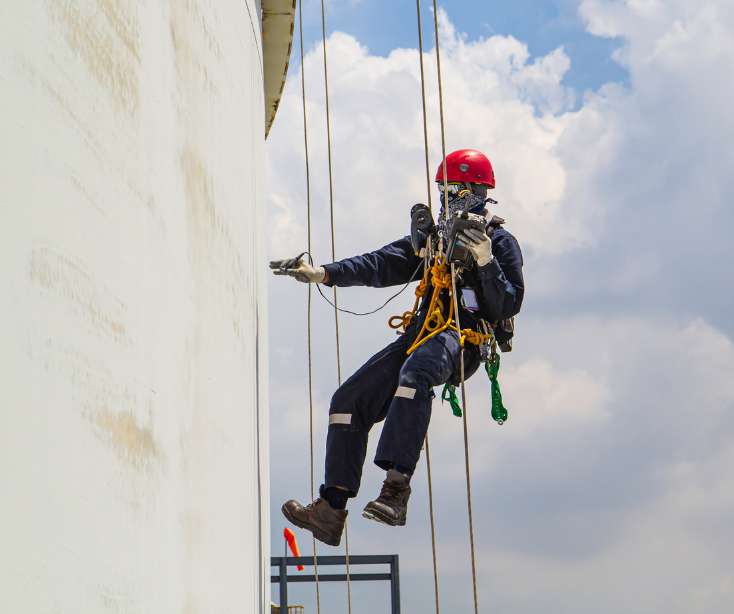
A Queensland height safety inspection regime, run on the right cadence with proper documentation, gives a PCBU a compliance position the regulator can audit and the operational confidence that the gear on site will perform when it has to. The framework is codified: AS/NZS 1891.4:2009 sets out inspection intervals for soft goods on a six-month cycle and fixed systems on a twelve-month cycle, every certified inspection must produce both a durable tag and a corresponding certificate, and Workplace Health and Safety Queensland’s enforcement focus on fall prevention is sharpening through 2026.
To book a site audit or drop soft goods at the Geebung facility, contact Aegis on 07 3865 1139 during weekday hours, or speak to the Chinchilla showroom team on 1800 234 477. Pre-handover inspections, six-month recertification of harnesses and lanyards, and roof safety inspection scoping can be arranged through either site.