
Why gas
detector
calibration
frequency
matters for
compliance
Here's a scenario that plays out on Australian worksites more often than safety managers would like to admit: a worker enters a confined space carrying a gas detector that is powered on without complaint, passes its self-test, and shows readings that look completely normal.
What nobody knows (honestly, because nobody has calibrated the device in fourteen months) is that the electrochemical sensor detecting H2SH_2S H2S has drifted significantly.
The actual concentration in the space is sitting at a level that should be triggering an alarm. The detector disagrees. The worker trusts the detector.
That's not a hypothetical. That's the specific failure mode that gas detector calibration exists to prevent.
Calibration vs. Bump Testing: Clearing the Confusion
These two terms get used interchangeably in a lot of workplace conversations, and they shouldn't be. They're different procedures that answer different questions, and understanding the distinction is fundamental to running a compliant gas detection maintenance program.
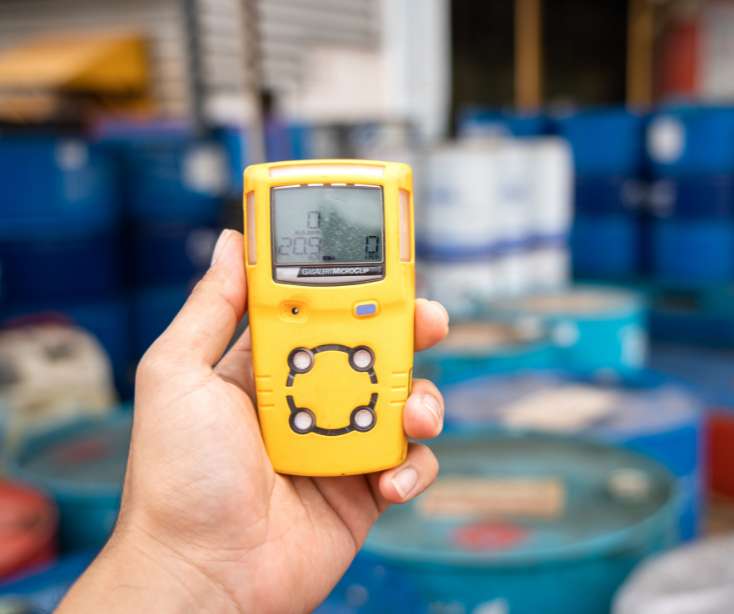
A bump test (which is also called a functional test or challenge test) answers one question; does this sensor respond to gas?
It involves briefly exposing the detector to a concentration of test gas and then confirming that the instrument alarms. It takes a minute or two. It should be done daily, or before every entry into a potentially hazardous atmosphere, at least.
What a bump test does not tell you is whether the sensor is reading accurately. A sensor that has drifted (as in one that detects gas but under-reads the concentration by 30%) will pass a bump test.
The alarm will sound. The sensor is technically responding. But the number on the display is wrong, and if that number is being used to determine whether an atmosphere is safe for entry, wrong is a problem with serious consequences!
Gas detector calibration answers the accuracy question. It involves exposing the instrument to a certified reference gas of precisely known concentration (which is traceable to national measurement standards) and comparing the instrument's reading against that known value.
Where there's a discrepancy, the instrument is adjusted until the reading matches the reference. The result is an instrument that you can actually trust, and not just one that turns on!
The Science of Sensor Drift: Why Accuracy Fades
Gas detector sensors don't fail dramatically. They don't stop working one day and start working the next. They degrade slowly, incrementally, and in ways that aren't visible and aren't caught by a self-test or a basic functional check.
This process is called sensor drift, and understanding it is the whole argument for regular calibration.
Electrochemical sensors work through a chemical reaction. Over time, that reaction becomes less efficient. The sensor's sensitivity decreases. It still responds to gas, but it takes more of it to produce the same reading.
Catalytic bead sensors (which are used for combustible gases) are vulnerable to a specific form of degradation called poisoning. Certain compounds, lead compounds, and halogenated hydrocarbons will coat the catalytic surface and permanently reduce its sensitivity. A poisoned catalytic bead sensor can pass a self-test and still fail to accurately detect a flammable gas concentration at the Lower Explosive Limit.
Environmental factors accelerate drift in the Australian context specifically. Extreme heat in Queensland and WA mining environments, humidity cycling in coastal industrial facilities, and sustained exposure to the compounds found in oil and gas processing will all push sensor degradation faster than laboratory service life ratings assume.
Australian Standards: What Does the Law Actually Require?
AS/NZS 60079.29.2 is the Australian and New Zealand standard governing the selection, installation, use, and maintenance of gas detection systems for explosive atmospheres.
For toxic gas detection, AS/NZS 4641 applies. Together these standards set the technical framework for what compliant maintenance looks like.
The standard's position on calibration frequency is deliberately not a fixed number. It requires a risk-based approach. The calibration interval should be determined by the manufacturer's recommendations, the operational environment, the history of the specific instrument, and the consequences of inaccurate readings in the application.
In practice, six months is the widely accepted baseline for most portable instruments in standard industrial use. But "six months" is a starting point for the risk assessment, not an answer that applies universally.
A portable detector used daily in a sour gas processing facility in Queensland operates in a fundamentally different environment from the same model sitting in a metropolitan utility maintenance vehicle. The risk assessment for the first instrument should almost certainly produce a more frequent calibration interval than six months.
The standard doesn't prescribe that interval. It just requires the PCBU to determine it, document the reasoning, and demonstrate that the approach is appropriate for the specific use case.
Keep in mind that state-based regulators (i.e. WorkSafe Victoria, SafeWork NSW, WorkSafe WA, Resources Safety and Health Queensland) will expect to see that assessment documented.
"We calibrate every six months because that's what everyone does" is a weaker position than "we calibrate every three months because our risk assessment identified these specific factors that accelerate sensor drift in our environment."
The 2026 WEL Transition: A New Demand for Precision
The shift from Workplace Exposure Standards (WES) to Workplace Exposure Limits (WEL) taking effect 1 December 2026 isn't just a terminology change. For a number of toxic gases, the permissible exposure values are lower under the new framework than they were under the old one.
Here's the specific problem sensor drift creates. Suppose that a carbon monoxide detector has drifted such that it reads 10% low. This is not unusual for an electrochemical sensor approaching the end of its service life or operating in a demanding environment. And under current WES thresholds, that 10% under-read might sit within an acceptable tolerance.
But under the new and lower WEL thresholds, that same drift could mean the instrument fails to alarm at a concentration that is now above the legal limit. The detector hasn't changed. The regulatory requirement has. And the only way to know whether the instrument is accurate enough to meet the new standard is to calibrate it against a certified reference gas.
In that regard, every instrument in service on 1 December 2026 that monitors gases affected by the WEL transition should have a calibration record that is dated after the relevant WEL values were established and confirmed to meet the new thresholds.
The Legal and Financial Cost of Non-Compliance
When a serious incident occurs on an Australian worksite involving atmospheric hazards, the sequence of events in the regulatory investigation is fairly predictable.
WorkSafe or SafeWork officers will attend the site. They will ask for the gas detection maintenance records, like calibration certificates, bump test logs, and instrument service histories. They will also ask when each instrument was last calibrated, by whom, against what reference gas, and what the result was.
A calibration certificate from a NATA-accredited laboratory (with a traceable reference gas standard and furthermore dated within the appropriate interval for the instrument and environment) is clear documentation that demonstrates a functioning and compliant safety management system.
It doesn't guarantee, however, that no prosecution will follow a serious incident (since other factors will be examined), but it is still evidence of due diligence that carries real weight.
The absence of calibration records (or records showing calibration intervals that weren't appropriate for the operating environment) is evidence of the opposite. Under the WHS Act, Person Conducting a Business or Undertaking - PCBUs - have a duty to make sure , so far as is reasonably practicable, the health and safety of workers. A gas detection program that can't demonstrate instrument accuracy through documented calibration is a program that hasn't met that duty.
Automating Compliance So the Frequency Never Gets Missed
The practical failure mode for calibration programs isn't usually ignorance of the requirement. It's operational pressure.
The calibration is due, the instrument is in the field on an active project, the contractor who does the calibration needs to schedule it, and somewhere in that process the interval slips from six months to eight months to "we'll get to it."
Modern gas detection management addresses this through docking stations and cloud-based fleet management software. Docking stations will automatically perform bump tests when an instrument is returned at the end of a shift, log the result with a timestamp, flag instruments that are approaching their calibration due date, and then in some configurations they will lock out instruments that are out of calibration from being used until the service is completed.
Cloud-based records create the audit trail automatically: every bump test, every calibration, and every alarm event are easily accessible in a format that can be produced immediately if a regulator asks for it.
For organisations that are managing large instrument fleets across multiple sites, automated fleet management isn't just a convenience.
It's the only realistic way to maintain calibration compliance at scale without relying on individual workers to remember when their specific instrument is due. Reach out today to Aegis Sales & Service to learn more about our ISO17025-accredited NATA Calibration Lab and calibration services.